Draft proposal · No agreement in place · Nothing has been awarded
Utah Life · A higher education proposal
A proposed open network where students hold their identity, credentials, agreements, and proof-and universities remain the authority on what they issue.
Starting with 111,794 students at three Utah universities.
Utah has a digital identity law and no evidence yet that it works at university scale. Two linked applications propose to build the reference implementation, test where it succeeds and fails, and publish the results and conformance suite either way.
Each university holds its own keys. The person holds their own record. No company sits in the middle.
The practical value comes first. The technical standard exists to make these experiences possible.
Share only the fact someone needs-such as enrolled: yes-while the rest stays with you.
Tuition, lunch, parking, or a campus paycheck without a student surcharge or pass-through fee.
Hold signed, verifiable recommendations that remain useful when people or institutions change.
Carry projects, service, and demonstrated skills without a hidden score, rank, or leaderboard.
Keep proof of who signed and exactly what they signed-without asking an office for a copy.
Let a school or employer verify degrees, certificates, and competencies in seconds.
Use campus groups and messaging on open protocols run by participating institutions.
Grant limited authority for one purpose, see what happened, and take that access back.
Today, a company or office usually holds your grades, money, signature, messages, and identity and lets you look at them. You are the subject of the file, not its owner.
This proposal tests another arrangement: disclose one fact at a time, choose who receives it and for how long, and walk away from any provider without losing what you earned.
The best artificial intelligence can remain available, but it becomes a tool you aim not a party you are exposed to.
SB 275 says identity is inherent to the person rather than bestowed by the state, requires minimum-necessary and selective disclosure and offline presentation, and bars surveillance use. No U.S. jurisdiction has tested those principles at population scale - nobody has published what such a system costs per verification, whether selective disclosure actually reduces exposure, or how it handles a lost phone, poor connectivity, a screen reader, or a student without a smartphone.
Utah legislated a principle. This project finds out whether it survives contact with 111,794 people.
Students at the three participating universities (USHE, fall 2025)
Students in the whole Utah system - the three are a majority
Utah counties reachable through USU Extension
Tested reference implementations at population scale today
Everything on this page rests on one small piece of machinery: the keys that prove a record is yours. Four questions every person actually asks - where keys come from, what happens when one is stolen, what happens when a phone is lost, and how an assistant can use any of this without learning who you are.
One secret on your device quietly produces a separate key for every place you use it. Nobody can connect them.
Retire a key and name its successor without changing who you are on the network.
A lost phone is an inconvenience not the loss of your degree, your money, or your history.
Your own directed intelligence uses a large model without ever handing it who you are.
Shown to the registrar
Shown to campus merchants
Shown to a counterparty
Shown to the comms server
Derivation runs one direction. A key can be produced from the root, but the root cannot be worked backward out of a key. Because each party is handed a different key, two of them comparing notes learn nothing: the registrar and the campus store hold values that look unrelated. This is what an automated system cannot follow. A platform, or a model, that sees your key at one place and your key at another has no mathematical way to know they belong to the same person. There is nothing to stitch. You do not memorize any of this and you never type a key.
Each entry in your record does two jobs. It signs with the key in force at that moment, and it seals a fingerprint of the key that will come next. The successor is committed before it is ever used, so a thief who takes today's key still cannot name tomorrow's. Rotating is a normal event in the log, not a new account.
A verifier replays this log from the beginning. It accepts a signature only if the key was in force at the sequence number where the signature was made.
Not one of these nodes can read your record. They hold a signed log and confirm what order it happened in. No node can issue a key. Only your root can.
Public, or private and non public
This is the difference between directed digital intelligence and artificial intelligence in one picture. Yours runs on your device, reads your record locally, and decides how little to ask. Theirs is very good at language and reasoning, and it gets exactly one scoped grant, under a key that was made for this request and will never be used again. When the grant expires the model holds nothing it could use to find you, and the next request arrives under a different key it has never seen. Public model or private one, the boundary is the same. You direct yours. Theirs hires theirs.
Rotation retires the old key in the same record that names the new one. The theft becomes a dated line in your history instead of the end of it.
The log says which key was in force when, so a transcript signed two years ago still verifies after four rotations. No re-issuance, no fees.
Your university can issue a credential and witness your log. It cannot rotate your keys or sign in your place - and neither can the company that built this.
Every request rides a key made for that request and never used again. Two requests share nothing a model could use to connect them.
The institutions are peers not branches of a platform. Each can revoke only what it issued, and none can read the others.
Everything is engineered and hosted from the Canopy campus in Lindon - the reference node, the witnesses, the hosting, the engineering. The keys are not. The standard in the middle is public and belongs to nobody; the keys stay with each university. Take the base away and the standard still exists and the keys still work.
Its own keys in its own hardware, its own issuance policy, its own revocation registry. It can revoke what it issued and nothing else. No node can issue on another node's authority or read another node's records.
In a wallet on their device. They choose what to present and to whom, one attribute at a time. Custodial recovery exists and is opt-in and separable - not a back door held by anyone by default.
KERI and ACDC for keys and authentic chained data, W3C Verifiable Credentials for format, OpenID4VP for presentation. The conformance suite is published open source so the state can check any vendor's claim - including ours.
There is no central database of who holds what, and nobody can list who verified what. A wallet that is a view onto someone else's server is not a wallet.
Utah's State-Endorsed Digital Identity statute, SB 275 as amended in February 2026, sets requirements. The LIFE Standard Reference Architecture maps each to a shipping component - this project is the first independent, instrumented test of whether that mapping holds at population scale.
The statute says identity is inherent to the person rather than conferred by government. The specification's first rule says the same: the member always owns the identity, credentials, data, personas, likeness, and relationships; the provider supplies infrastructure, not ownership. Specification: Digital World Engineering Specification v3, section 16, published at docs.digitalworld.earth. The conformance suite built against it is a funded deliverable released open source.
Every one is a real transaction with a real current cost - which is what makes the measurement meaningful.
Funded inside the awards where the application says so, gated by counsel where noted.
Not in either application - listed so the roadmap is visible and the scope is honest.
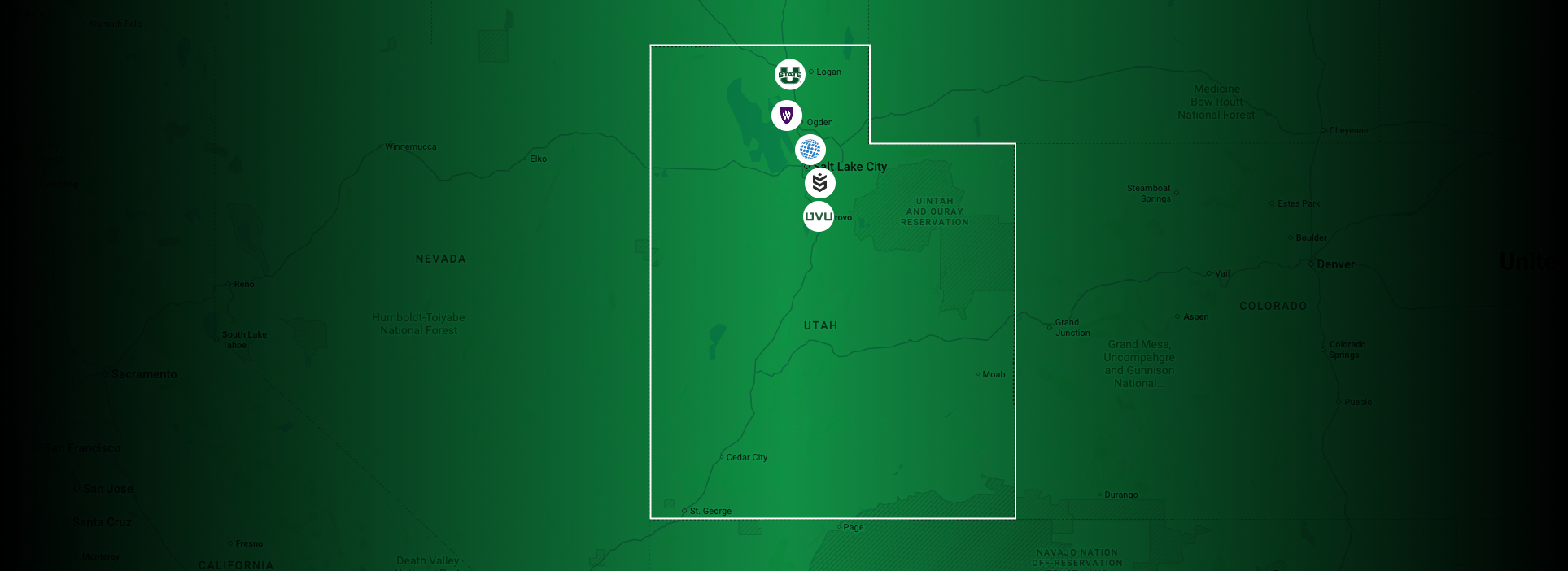
UVU first, and to depth - largest student body in Utah and home of the principal investigator. Enrollment verification, then degrees, then competencies.
Utah State second, for the rural question - Extension offices in all 29 counties, sites chosen for bad connectivity rather than convenience.
Weber State third, deliberately last - a third team stands up a node from the published specification alone, with no hands-on help. If they cannot, the reference implementation is not reusable, and we would rather learn that inside the award.
Cross-node verification - a credential issued by one node, presented at another, verified with no call back to the issuer.
Publish - cost per verification, minimization actually achieved, and every failure mode found, released as a public dataset with a reproducibility package.
Credential issuance, verification, portability, a conformance suite, trust framework, and adversarial security research.
A pro-human AI agent bound to student-held credentials, with scoped delegation, a consent ledger, and measurement of human agency.
The proposal states that both applications include a cost crosswalk so no person, equipment item, or cost line is charged twice.
An additional $3.5 million in cost share is offered; its schedule is incomplete.
This page presents a proposal, not an operating university program. The published results would include costs, privacy outcomes, and every failure mode found.